Where Do Words Disappear?
By Sami Bsoul, PhD
Everyone chases the origin of words. Etymology. First use. Ancient roots. I'm also into that much. But here it is not my question.
My question: Where do words go when they are out of people's mouths? Why do the same words land like a punch in one person's head and vanish like smoke in another's?
Here's the mechanism.
No word carries intrinsic emotion. Through repeated pairing, words can acquire learned associations, semantic conditioning, but at birth, every word is a blank tile. Water is neutral until thirst. Sex is neutral until you lack it or suck at it. Death is a process, neither sad nor happy on its own. The whole dictionary works the same. You assign the feeling. Then you forget you assigned it. You blame the word.
Now watch what happens when different people hear the same word.
I asked my Japanese friend: "How would you react if someone calls you a donkey?" He looked at me. Then said: "I tell him he is a lion." He thought it was just a game question.
No laugh. No offense. He didn't assign shame or meaning to my question. The word landed on him like a stranger asking for nothing. He didn't load it. He responded with a counter-word, not with emotion. (For the psychological mechanism, how cultural context frames threat appraisal, you can see Mesquita & Frijda, 1992, on cultural variations in emotion.)
In other parts of the world, that same word, donkey, can get you killed. I'm not guessing. Honor cultures exist where an insult to lineage or intelligence triggers retaliation. In parts of Afghanistan or Somalia, for example, calling someone a donkey or comparable animal has led to a serious violent response. The word doesn't change. The listener's threat detection system does.
So where does the word go in my friend's head? It never became a weapon because he did not arm it. The word didn't disappear. The threat did.
Same principle applies to written words and how we use them every day. Watch this. Someone sends you a long email, explaining, analyzing, reacting on a topic, but closes with "No need to respond."
Look at the pattern, not the phrase in isolation. If the same person consistently sends long messages and then blocks reply, that pattern reveals an intent: 'I want my words heard, but I won't risk yours.' Or worse: 'I know better than you, so your reply won't change anything.' The sender vanishes the return path. That's not "saving your time." That's a monologue wearing a mask. The words go out. The dialogue disappears. The receiver, who still has the option to write back, notices the pattern: the sender is so invested in their own voice that they preemptively silence the other. (And yes, sometimes "no need to respond" is genuine respect for time. The critique here is only when the pattern shows otherwise.)
Years ago, I had a colleague. She could be sharp with another new colleague who just joined the company, here and there, not repeated, but occasionally her words landed hard. Everyone in the office who saw those moments hated her for them. They jumped on her. Called her cruel. I watched her over weeks. I saw the pattern: tens of small caring acts, patience, support. I knew one thing: she loved him. Very much. At the end, they got married.
How can both "she was sometimes harsh" and "she loved him" be true? Because the colleagues assigned meaning to isolated syllables. One angry sentence = "she hates him." I assigned meaning to the pattern. Tens of small caring acts over time = "she loves him." Same woman. Same words. Two observers, the colleagues and I, reached completely different conclusions.
The difference? The colleagues stopped at the sound. I kept watching.
So where do words disappear? They don't vanish into thin air. They disappear into the observer's frame. They vanish into your past conditioning, your cultural wiring, your brain's threat assessment. When you hear one insult, your threat circuits (LeDoux, 1996) activate before your cortex catches up. You react to the ghost of a word instead of tracking the behavior that matters. The word didn't vanish. Your attention did. The disappearance is not a magic trick. It's a failure of pattern recognition.
Same principle applies to the three words people chase most: "I love you."
Neutral syllables. Air and sound. No more than "donkey" until you load them. And people load them with everything except pattern.
They load them with intensity. With the rush of being chosen. With the terror of losing someone. With the comfort of familiarity mistaken for compatibility. They hear "I love you" and stop watching. One sentence = "this is real."
You've said "I love you." You've heard it. But have you ever watched what came after?
Most people never check if the pattern matches the sound. That silence is where my book begins.
Here's the quiet disaster: people spend years defending three words "I love you" while ignoring years of behavior.
This is what my book maps. Not love as an idea. But where it actually happens: in small silences, in overthinking, in attachment that forms before understanding arrives. The question is never whether someone says the words. The question is whether the pattern over weeks and months matches the sound.
Because the same person who says "I love you" can also leave you confused, waiting, hollow. That's not love. That's inconsistency. Words don't tell you which is which. Watching does. And when the pattern contradicts the promise, the words are just noise.
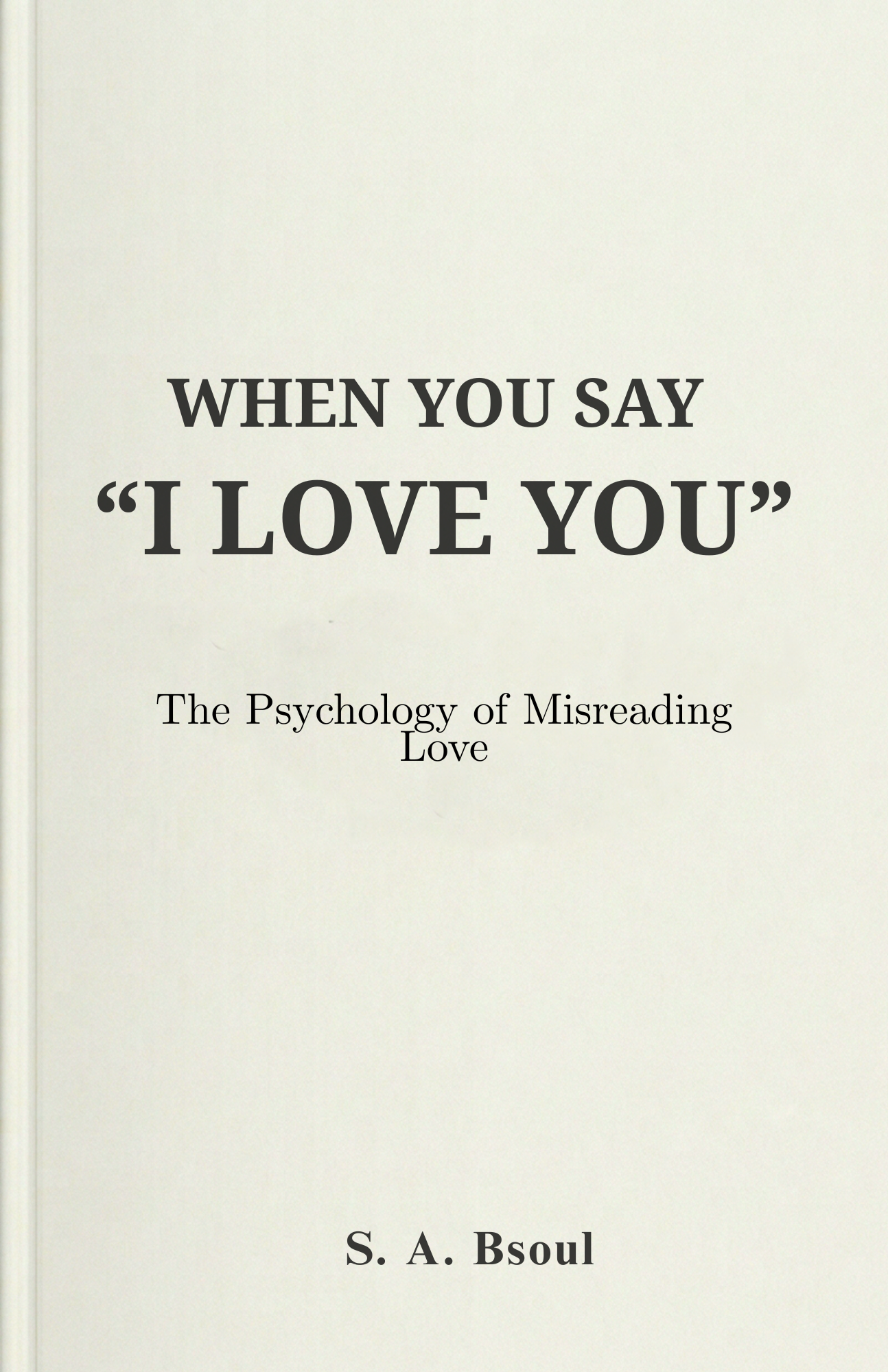
The book is called When You Say "I Love You". It maps how clarity is lost. And how to get it back.
Most people don’t lose themselves in relationships suddenly. It happens through repeated adjustment under emotional pressure. When connection feels important, the nervous system prioritizes safety over authenticity. Preferences are suppressed. Reactions are controlled. Parts of the self are gradually removed to avoid tension or distance. This reduces conflict. But it also reduces self-expression. Over time, the relationship feels easier. But the individual feels less present inside it. What looks like compatibility is often self-editing. And what feels like love can become the process of slowly replacing who you are with what is easier to keep. #whenyousayiloveyou
@sami.bsoul Most people don’t lose themselves in relationships suddenly. It happens through repeated adjustment under emotional pressure. When connection feels important, the nervous system prioritizes safety over authenticity. Preferences are suppressed. Reactions are controlled. Parts of the self are gradually removed to avoid tension or distance. This reduces conflict. But it also reduces self-expression. Over time, the relationship feels easier. But the individual feels less present inside it. What looks like compatibility is often self-editing. And what feels like love can become the process of slowly replacing who you are with what is easier to keep. #whenyousayiloveyou ♬ original sound - Sami Bsoul
Intermittent warmth is not a personality trait. It is a behavioral signature of unspoken dominance. Emotional inconsistency is often misread as complexity or personality. But inconsistent behavior changes how attention is distributed in a relationship. Unpredictability activates the brain’s need to resolve uncertainty. This increases focus, monitoring, and emotional investment. Not because the connection is deeper. But because it is unstable. Over time, one person becomes the source of emotional rhythm, while the other adapts to maintain stability. What appears as attraction can become regulation. And what feels like connection can shift into dependence on inconsistency. #whenyousayiloveyou
@sami.bsoul Intermittent warmth is not a personality trait. It is a behavioral signature of unspoken dominance. Emotional inconsistency is often misread as complexity or personality. But inconsistent behavior changes how attention is distributed in a relationship. Unpredictability activates the brain’s need to resolve uncertainty. This increases focus, monitoring, and emotional investment. Not because the connection is deeper. But because it is unstable. Over time, one person becomes the source of emotional rhythm, while the other adapts to maintain stability. What appears as attraction can become regulation. And what feels like connection can shift into dependence on inconsistency. #whenyousayiloveyou ♬ original sound - Sami Bsoul
People often assume that strong feelings reveal the truth about a relationship. Psychologically, that is not always accurate. Emotional intensity can come from attachment patterns, nervous system familiarity, unresolved experiences, and repeated emotional conditioning. What feels powerful can sometimes be the brain responding to uncertainty rather than connection. This is why calm is often questioned while instability feels meaningful. Love itself is not what creates confusion. Confusion usually begins when emotional activation is mistaken for relational truth. Real clarity does not come from what is felt in a moment. It comes from what is repeated over time. #whenyousayiloveyou
@sami.bsoul People often assume that strong feelings reveal the truth about a relationship. Psychologically, that is not always accurate. Emotional intensity can come from attachment patterns, nervous system familiarity, unresolved experiences, and repeated emotional conditioning. What feels powerful can sometimes be the brain responding to uncertainty rather than connection. This is why calm is often questioned while instability feels meaningful. Love itself is not what creates confusion. Confusion usually begins when emotional activation is mistaken for relational truth. Real clarity does not come from what is felt in a moment. It comes from what is repeated over time. #whenyousayiloveyou ♬ original sound - Sami Bsoul
© Samibsoul.com 2026
Mesquita, B., & Frijda, N. H. (1992). Cultural variations in emotions: A review. Psychological Bulletin, 112(2), 179–204.
LeDoux, J. E. (1996). The emotional brain: The mysterious underpinnings of emotional life. Simon & Schuster.









2023 Samibsoul.com ©